
1. How to calculate volume: getting length × width × height right
1.1 The basic formula
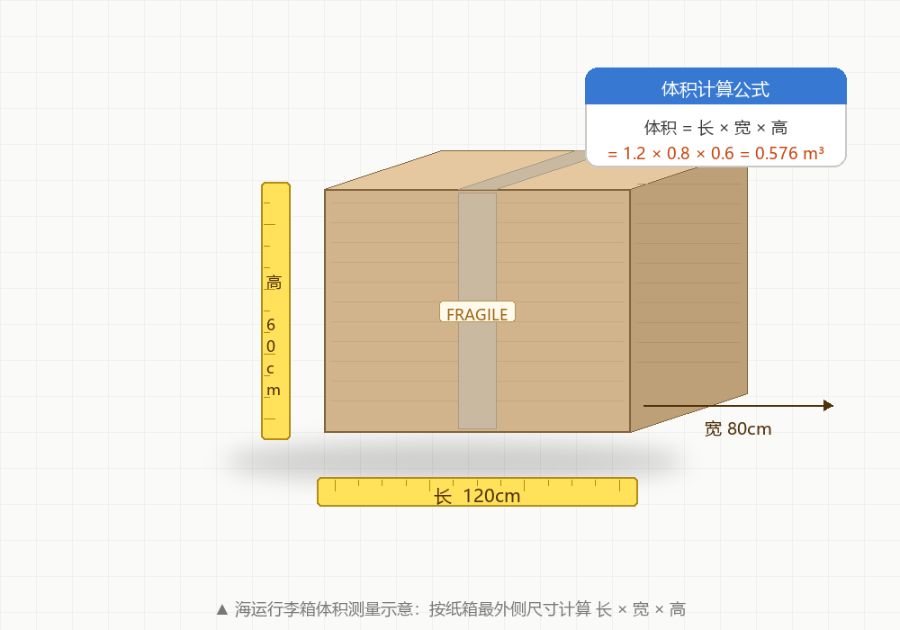
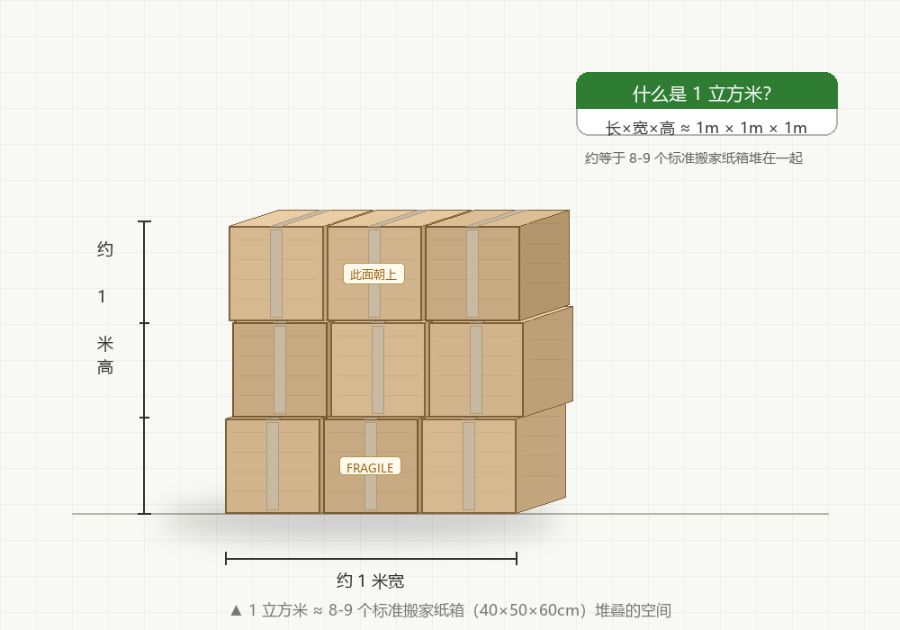
Say you have a standard moving carton measuring 40cm × 50cm × 60cm. Convert to meters and you get 0.4 × 0.5 × 0.6 = 0.12 cubic meters. Stack eight or nine of those cartons together and you're at roughly 1 cubic meter.
The image below walks through how the volume of a piece of furniture 120cm long, 80cm wide and 60cm high gets calculated:
1.2 Why your measurement and the warehouse's don't match
This is the argument that comes up more than any other: the customer measures 8 cubic meters at home, the warehouse packs everything and reports 10. Where does the gap come from? Three things, mostly:
- Packing has thickness. Cartons, corner protectors, bubble wrap and wooden crates all take up room, and every side gains a few centimeters once an item is packed.
- Furniture has gaps. Oddly shaped chairs, lamps and irregular pieces can't be stacked flush against each other.
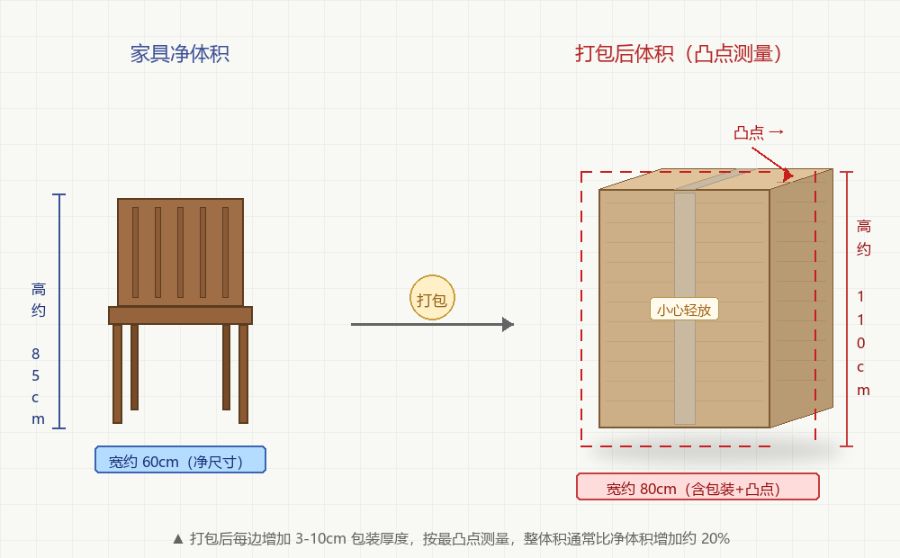
- Everything is measured at the widest point. Not the furniture's nominal dimensions, but the bulgiest spot once it's packed.
💡 Rule of thumb from the industry: take your own net volume estimate and multiply by 1.2. That's roughly the packed volume.
1.3 How volume relates to weight
Sea freight moving is priced by volume, not weight, because a ship's capacity is about space rather than how much weight it can carry. There is one exception:
- Roughly 200 kg per cubic meter is the cap, and going over can trigger an overweight surcharge
- Ordinary furniture and clothing fall far short of that density (a cubic meter of clothes weighs about 100-150kg), so it's rarely a concern
- High-density items such as books, tiles and metal parts need attention. Books get heavy fast, so keep an eye on it when packing
2. How big is 1 cubic meter, really?
"1 cubic meter" sounds abstract. What does it actually look like? The image below and a few everyday objects will give you a feel for it:
 Quick comparisons using everyday objects:
- Standard moving carton: 40×50×60cm, eight or nine stacked together ≈ 1 cubic meter
- Side-by-side refrigerator: one ordinary unit comes close to 1 cubic meter
- 28-inch suitcase: seven or eight packed with clothes ≈ 1 cubic meter
- Picture the space: it's a cube an adult can't wrap their arms around
For the volume ranges typical of different households, jump to section 6 at the end, "Three quick ways to estimate volume". For per-item figures on furniture, appliances and clothing, keep reading: sections 3, 4 and 5.
3. Volume reference for common furniture
This is the practical part. Every figure below is an estimate for a packed item. Actual numbers vary quite a bit by brand, style and whether the piece gets disassembled, so treat them as rough guides only.
📐 How measuring works: the international moving industry measures straight lines at the widest points. Not the furniture's nominal dimensions, but length, width and height taken at the bulgiest part of the packed item. Bulging cartons, protruding corner protectors and outward-bulging wooden crates all make the volume bigger than you'd expect. On average, packing adds about 20% to net volume.
The image below shows the difference between net volume and packed volume:
3.1 Bedroom furniture
| Item | Reference volume (packed) | Notes |
|---|---|---|
| 1.8 m double bed (disassembled) | 1.0 - 1.5 cubic meters | Headboard, frame and slats; breaking it down shrinks it a lot, and assembled it can double |
| 1.5 m double bed (disassembled) | 0.8 - 1.2 cubic meters | Same as above |
| Single bed (disassembled) | 0.5 - 0.8 cubic meters | |
| Mattress (1.8 m) | About 1.0 - 1.1 cubic meters | 1.8×2×0.3m; big but light, and it can be compressed to save space |
| Four-door wardrobe (disassembled) | 1.5 - 2.5 cubic meters | Panel wardrobes aren't large once broken down, but mind the hardware during the move |
| Three-door wardrobe (disassembled) | 1.0 - 1.8 cubic meters | |
| Two-door wardrobe (disassembled) | 0.6 - 1.2 cubic meters | |
| Solid wood wardrobe (assembled) | 2.0 - 3.5 cubic meters | Solid wood wardrobes can't be taken apart: large and heavy |
| Vanity + stool | 0.3 - 0.6 cubic meters | Mirrors need special packing |
| Nightstand × 1 | 0.1 - 0.2 cubic meters | Two comes to 0.2-0.4 m³ |
3.2 Living room furniture
| Item | Reference volume (packed) | Notes |
|---|---|---|
| Three-seat sofa (assembled) | 1.5 - 2.5 cubic meters | The biggest single item in the room; removable legs save around 20% |
| Two-seat sofa | 1.0 - 1.5 cubic meters | |
| Armchair / single chair | 0.5 - 1.0 cubic meters | |
| L-shaped sofa | 2.5 - 4.0 cubic meters | Sectional sofas are easier to manage once separated |
| Coffee table | 0.2 - 0.5 cubic meters | Glass or marble tops need reinforced packing |
| TV stand | 0.3 - 0.8 cubic meters | Long TV stands add up |
| Bookcase (disassembled) | 0.5 - 1.5 cubic meters | Depends on the number of shelves and the size |
| Side table / corner table | 0.1 - 0.3 cubic meters | |
| Screen / room divider | 0.3 - 0.8 cubic meters | Glass screens need extra reinforcement |
3.3 Dining room and study
| Item | Reference volume (packed) | Notes |
|---|---|---|
| Dining table (legs off) | 0.3 - 0.6 cubic meters | Small once the legs come off; leave them on and it can double |
| Dining chair × 1 | 0.15 - 0.3 cubic meters | Four chairs come to 0.6-1.2 m³, and stacking them saves space |
| Sideboard / wine cabinet | 0.5 - 1.5 cubic meters | |
| Desk (legs off) | 0.2 - 0.5 cubic meters | |
| Desk chair / office chair | 0.15 - 0.3 cubic meters | Swivel chairs run a bit larger |
| Filing cabinet | 0.3 - 0.8 cubic meters |
💡 Key point: if a piece of furniture can be disassembled, take it apart. Beds, dining tables, wardrobes and desks often lose 30%-50% of their volume once the legs or panels come off. Bag the screws and fittings separately and label each bag (something like "1.8 m bed screws"), and assembly in France won't leave you staring at a pile of parts.
4. Appliance and household goods volume reference
4.1 Common large appliances
| Appliance | Reference volume (packed) | Notes |
|---|---|---|
| Side-by-side refrigerator | 0.8 - 1.2 cubic meters | One of the largest items in this category |
| Three-door / two-door refrigerator | 0.5 - 0.8 cubic meters | |
| Front-loading washer | 0.3 - 0.5 cubic meters | |
| Top-loading washer | 0.3 - 0.5 cubic meters | |
| Dryer | 0.3 - 0.5 cubic meters | About the same size as a washer |
| Floor-standing AC unit | 0.4 - 0.7 cubic meters | Add more if the outdoor unit goes too |
| Microwave / oven | 0.1 - 0.2 cubic meters | |
| Dishwasher | 0.3 - 0.5 cubic meters | |
| TV (55-inch) | About 0.15 - 0.25 cubic meters | The screen is fragile: original box plus reinforcement |
| TV (65-inch) | About 0.25 - 0.4 cubic meters | |
| Desktop computer | About 0.03 - 0.05 cubic meters | Tiny when boxed, but check whether the built-in battery can go by sea |
4.2 Kitchen and household items
| Item | Reference volume | Notes |
|---|---|---|
| Rice cooker / pressure cooker | 0.05 - 0.1 cubic meters each | |
| Pots, pans and dishes (one box) | 0.1 - 0.15 cubic meters per box | Fragile items need cushioning |
| Tableware / glassware (one box) | About 0.1 cubic meters per box | Foam, bubble wrap and a carton for multiple layers of protection |
| Small appliances (one box) | 0.1 - 0.15 cubic meters per box | Hair dryers, blenders, vacuum cleaners and the like |
| Cleaning tools | 0.1 - 0.3 cubic meters | Vacuum cleaners, mops, brooms and so on |
5. How to estimate clothing and books
Clothing and books are the two categories with the most pieces and the hardest volumes to pin down. You don't need to count every item; the methods below give you a fast estimate.
5.1 Clothing: estimate by wardrobe and suitcase
| Type of clothing | Reference volume | Notes |
|---|---|---|
| Clothing from one double-door wardrobe | About 1.0 - 1.5 cubic meters | Hanging plus folded; more for fall and winter clothes, less for summer |
| Vacuum bag of quilts | About 0.1 - 0.2 cubic meters per bag | Vacuuming shrinks it a lot; skip that step and it can double |
Quick estimate:
- Two large wardrobes in the home → about 2-3 cubic meters of clothing
- One wardrobe plus five or six suitcases → about 1.5-2 cubic meters
- Single or renting, clothing in two or three suitcases → under about 0.5 cubic meters
5.2 Books: estimate by box and weight
| Number of books | Reference volume | Reference weight | Notes |
|---|---|---|---|
| 30-40 ordinary books | About 0.05 - 0.08 cubic meters | About 10-15 kg | A small book box you can lift one-handed |
| Standard book box (about 40×30×30cm) | About 0.036 cubic meters | About 10-15 kg | A book box that fills up right to the top |
| One ordinary bookshelf (5 shelves) | About 0.3 - 0.6 cubic meters | About 80-150 kg | Depends on how tightly packed it is and the size of the books |
6. Three quick ways to estimate volume
No need to measure everything with a tape. These three methods run from rough to precise; pick the one that fits.
Method one: estimate by rooms (roughest, ±30%)
Best for: you've just started thinking about moving and want a rough order of magnitude.
- One-bedroom or studio apartment → everything you own, about 5-10 cubic meters
- Two-bedroom or small family → about 10-20 cubic meters
- Three-bedroom or family of three → about 20-30 cubic meters
- Large home or four-bedroom → about 30-50 cubic meters
Then ask yourself two questions to fine-tune:
- How much furniture, and how big? (Lots of solid wood → adjust up; few pieces from a rental → adjust down)
- Is your stuff minimal or packed to the rafters? (Minimalist → subtract 20%; a serious stockpiler → add 30%)
Method two: the big-item list (moderate accuracy, ±15%)
Best for: you already know which large furniture pieces you have.
Steps:
- Print the furniture tables from sections 3 and 4 above, or save them on your phone.
- Go through your large items (beds, sofas, wardrobes, refrigerators, washers, dining tables, TV stands and so on) and tick them off one by one against the tables.
- Add the volumes together to get your "total for large items".
- Multiply by 1.5 to 2 to cover small clothing, odds and ends, books, kitchen items and packing materials.
- The result is your total estimate.
For example: large items add up to 8 cubic meters × 1.8 ≈ 14.4 cubic meters, your estimated moving volume.
Method three: an on-site survey (most accurate, ±5%)
Best for: you've decided to move and need an accurate quote.
Professional international moving companies offer a free on-site survey. A staff member comes with tools, counts through each room, takes notes as they go, and gives you a fairly accurate volume estimate and quote on the spot.
It's the most reliable route:
- They can assess on site which furniture needs disassembly and which needs a wooden crate
- They spot oversized or overweight items in advance
- They answer questions about customs clearance, insurance and transit times on the spot
- The quote is far more accurate than your own estimate
7. What drives volume up, and how to cut it
The same belongings packed differently can vary in volume by 20%-40%. Want to save money? Start here.
7.1 Disassembly: if it comes apart, take it apart
| Item | Volume difference, disassembled vs not | Recommendation |
|---|---|---|
| Bed | Assembled, it can be 1.5-2 times the disassembled volume | Always disassemble; bag and number the screws |
| Dining table | Legs off cuts volume by 50%-70% | Always take the legs off; protect the top with corner guards |
| Wardrobe | Fully disassembled panel wardrobes lose 60%+ | Take it apart if you can; solid wood assemblies can't be broken down |
| Sofa | Removing the legs saves about 20% | Take the legs off when possible; fabric sofas can be vacuum compressed |
| Desk | Legs off cuts volume by 40%-60% | Disassembly recommended |
⚠️ A note on disassembly: put every screw, fitting and part in a sealed bag with a label (something like "1.8 m bed screws"), so assembly in France goes smoothly.
7.2 Compressing clothing: vacuum bags are volume killers
- Quilts, down jackets and heavy coats → vacuum compression cuts volume by 50%-70%
- Ordinary clothing → vacuum compression cuts 30%-40%
- A box of vacuum bags costs a few dozen yuan and can save you half a cubic meter of sea freight. That's a good trade.
Note: choose the thicker bags, since sharp objects in transit puncture thin ones easily. For suits and coats that wrinkle badly, vacuum compression isn't recommended.
7.3 Fill the gaps: small items into big spaces
- Cabinets and drawers can hold clothing, towels and bedding (but don't overload them)
- Under chairs and inside an emptied refrigerator, small items fit
- Pots and pans stack Russian-doll style, with paper between them
This is called nested loading, and done well it saves 5%-10% of your volume. Just remember: nothing overweight, nothing sharp and nothing liquid.
7.4 The decluttering principle: if you haven't used it in a year, you probably won't
Ask whether the sea freight to France is worth it for each individual item. That's the fundamental question:
- A plain T-shirt can be bought in France, and shipping it may cost more than the shirt itself
- Sentimental items, furniture you're used to, things clearly better value back home → worth shipping
- Cheap things, things you can buy again, things you haven't touched in six months → probably not worth it
A round of decluttering before departure cuts volume and freight, and gives your new life a clean start.
A final word
Volume estimation is the first step in a sea-freight move and the one where people trip up most. When estimating on your own, err on the high side: overestimate and you might save on freight, underestimate and a last-minute price increase is far more annoying.
If you're planning a sea move to France, the most reliable route is a professional moving company's free on-site survey. One look from someone who does this daily beats three days of measuring at home.